Understanding Your Brain
A Practical Guide to Mental Energy and Clarity

Brain Awareness: Learning to Care for the Organ That Shapes Your Life
Most of us spend our lives using our brains without ever really understanding them.
We know how to maintain a car. We stretch our muscles after exercise. We pay attention to our heart health and our sleep. Yet the organ responsible for every thought, decision, memory, and emotion often receives the least intentional care.
The brain quietly powers everything we do. And when it is overloaded, exhausted, or under-supported, we feel it in subtle but significant ways: difficulty concentrating, emotional reactivity, fatigue, or the sense that our mind simply cannot keep up.
Brain awareness is the practice of developing a more informed relationship with the brain that runs your life. It means understanding how the brain works and making small, consistent choices that support its health and function.
This is not about becoming a neuroscientist. It is about learning enough about your brain to treat it with the care it deserves.
The Brain Is a Living Biological System
One of the most important things to understand about the brain is that it is not simply a thinking machine. It is living biological tissue that depends on energy, oxygen, chemical signaling, and constant communication with the body.
Despite accounting for only about two percent of body weight, the brain uses roughly twenty percent of the body’s total energy (Raichle & Gusnard, 2002). It is one of the most metabolically demanding organs we have.
Neurons communicate through electrical impulses and chemical messengers called neurotransmitters. Blood flow delivers oxygen and glucose that power these signals. Hormones influence mood and attention. Even the immune system plays a role in brain function.
In other words, your mental clarity is not just about willpower. It is about biology.
When people say they feel “mentally drained,” that experience often reflects a very real depletion of the brain’s resources. Stress hormones may be elevated. Cognitive systems may be overloaded. Sleep may not have provided adequate restoration.
Brain awareness begins with recognizing that your mind is inseparable from your physical body.
Why Brain Awareness Matters
Many of the challenges people experience today involve brain systems that are under constant pressure:
Chronic stress
Information overload
Sleep disruption
Emotional fatigue
Decision fatigue
All of these place demands on neural networks responsible for attention, regulation, and executive function.
Several key brain systems are involved.
The prefrontal cortex sits behind the forehead and is responsible for planning, decision-making, emotional regulation, and impulse control. When this region is functioning well, we think clearly and respond thoughtfully.
But under stress, the brain reallocates resources toward survival systems. The amygdala, which detects potential threats, becomes more active. The nervous system shifts toward protective responses such as fight, flight, or freeze.
When this happens, the prefrontal cortex becomes less efficient. Logic and reasoning are harder to access. Emotional reactions become faster and more intense.
Understanding this changes the way we interpret our experiences.
Instead of asking, “What is wrong with me?” we can ask a different question:
What is my brain responding to right now?
That shift alone creates space for curiosity instead of self-judgment.
Your Brain Is Predictive
Another key insight from modern neuroscience is that the brain is constantly making predictions.
Rather than simply reacting to the world, the brain uses past experiences to anticipate what will happen next. This predictive process helps the brain conserve energy and respond quickly.
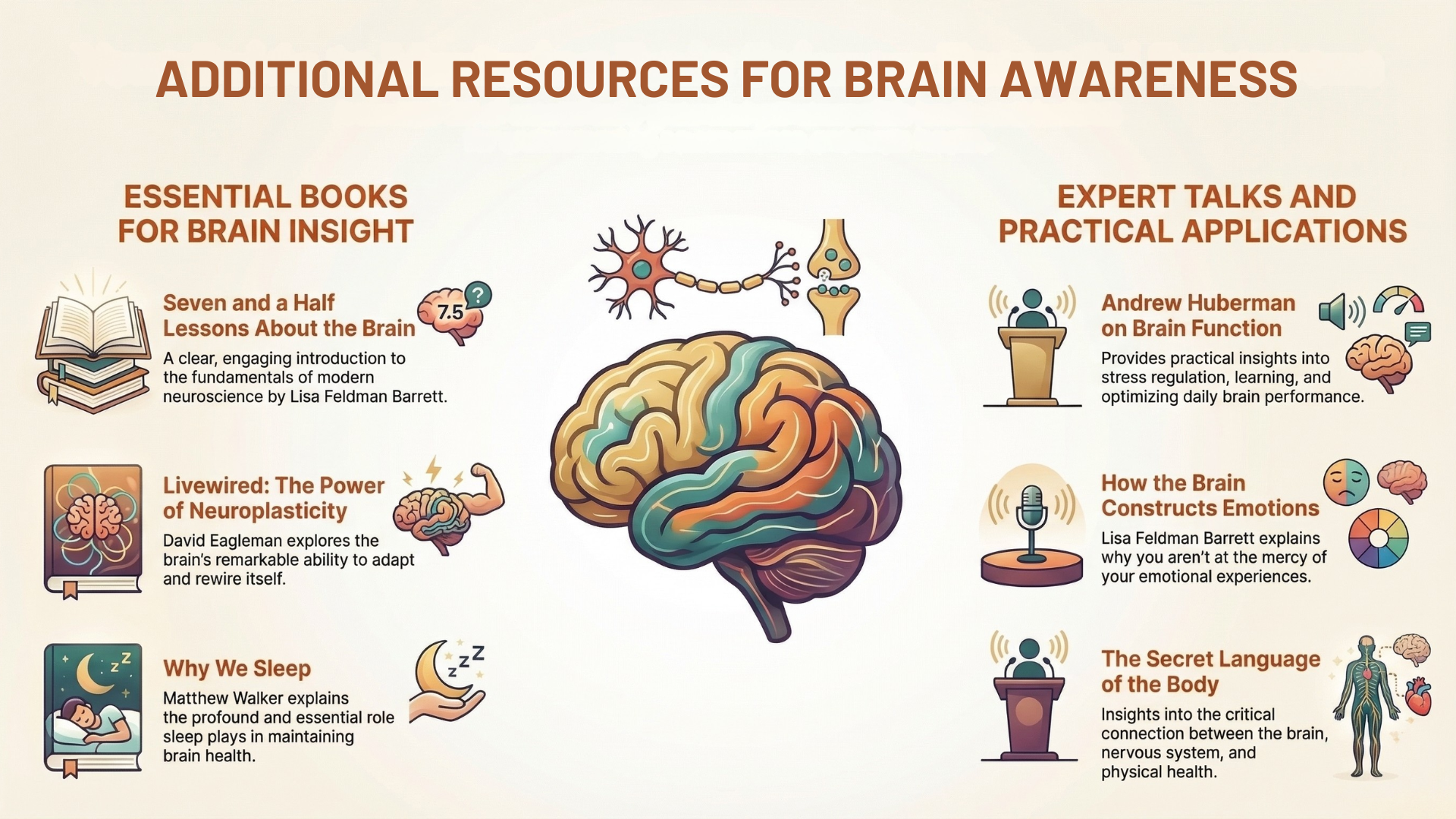
Psychologist and neuroscientist Lisa Feldman Barrett describes the brain as a system that continually constructs meaning by integrating memory, sensation, and expectation.
This means our past experiences shape how we interpret the present. It also means the brain can update those predictions through new experiences and learning.
This adaptability is known as neuroplasticity.
Neuroplasticity allows the brain to form new neural connections, strengthen useful pathways, and gradually reshape habits of thought and behavior.
Brain awareness involves recognizing that your brain is always learning from what you repeatedly do, think, and experience.

Brain Awareness in Daily Life
Brain awareness is not about drastic changes or complicated routines. It is about everyday practices that support the brain’s natural processes.
Small adjustments can significantly improve mental clarity, emotional regulation, and resilience.
Protect Sleep as Essential Maintenance
Sleep is one of the most powerful forms of brain care.
During sleep, the brain performs essential housekeeping. The glymphatic system clears metabolic waste from neural tissue. Memories are consolidated. Emotional circuits recalibrate.
Research shows that inadequate sleep reduces activity in the prefrontal cortex while increasing reactivity in the amygdala. In practical terms, this means less emotional regulation and more stress sensitivity.
Consistent sleep schedules, reducing bright light before bedtime, and allowing enough time for rest can dramatically improve brain performance.
Matthew Walker’s book Why We Sleep offers an excellent exploration of the science behind sleep and brain health.
Move Your Body to Support Your Brain
Movement is not only beneficial for muscles and cardiovascular health. It is also one of the most effective ways to support brain function.
Physical activity increases blood flow to the brain and stimulates the production of brain-derived neurotrophic factor (BDNF), a protein that helps neurons grow and strengthen their connections.
Even moderate movement, such as walking, has measurable cognitive benefits. It improves mood, enhances learning, and helps regulate stress hormones.
A brief walk between meetings or stretching during breaks can act as a powerful reset for the brain.
Reduce Cognitive Overload
The brain’s working memory has limited capacity. Most people can actively hold only a small number of pieces of information in mind at once.
When we try to juggle too many tasks, notifications, and decisions simultaneously, the brain becomes strained. This cognitive overload can lead to mental fatigue and reduced focus.
Brain awareness encourages externalizing information whenever possible.
Writing things down, structuring work into focused blocks, and reducing unnecessary digital interruptions can significantly reduce cognitive load.
This allows the brain to focus its energy on meaningful thinking rather than constant task switching.
Practice Nervous System Regulation
The brain continuously monitors the environment for signals of safety or threat. When the nervous system detects danger, even subtle forms of stress, it shifts into protective modes that prioritize survival over reflection.
Simple practices can help regulate this response.
Slow breathing, stepping outside for fresh air, grounding attention in physical sensations, or taking a few moments of quiet reflection can help calm the nervous system.
These brief pauses signal safety to the brain and allow the prefrontal cortex to regain influence over emotional responses.
Even two minutes of slower breathing can help shift the nervous system toward a calmer state.
Be Intentional About Your Mental Inputs
The brain is shaped by what it repeatedly encounters. Information, conversations, and environments influence neural pathways over time.
Brain awareness includes paying attention to mental inputs.
Are the ideas and information you consume daily expanding your understanding, or increasing anxiety and distraction?
Just as nutrition affects the body, the information we absorb affects the brain.
Curating thoughtful inputs such as meaningful conversations, learning opportunities, and reflective reading can support healthier mental patterns
Brain Care Is Ongoing Maintenance
Many people think about mental health only when something feels wrong.
But brain awareness suggests a different approach.
The brain benefits from regular care in the same way that muscles benefit from exercise or teeth benefit from brushing.Sleep, movement, emotional awareness, learning, and connection are not luxuries. They are part of the brain’s maintenance system.
Consistent, small actions support the brain’s ability to adapt, regulate emotions, and sustain attention.
Over time, these habits strengthen the neural systems that help us navigate complexity, manage stress, and think clearly.
A Final Thought
Your brain is constantly learning.
Every conversation you have, every experience you repeat, every habit you reinforce shapes neural pathways that influence how you think, feel, and respond to the world.
Brain awareness is simply the practice of becoming a better steward of that process.
It invites a shift from operating on autopilot to developing a thoughtful relationship with the organ that shapes your life.
When we understand the brain a little better, we often become more patient with ourselves. We recognize that clarity, resilience, and emotional balance are not simply personality traits.
They are biological capacities that can be supported, strengthened, and cultivated over time.
And that awareness is the first step toward caring for the mind that carries us through every moment of our lives.