
From Rumination to Resolution
Why thinking about something repeatedly is not the same as processing it

There is a particular kind of thinking that feels productive from the inside.
You replay the conversation. You analyze what they said. You imagine what you should have said. You revisit the decision, the mistake, the uncertainty, the awkward moment, the unresolved tension. You turn it over and over, almost like if you think about it one more time, it will finally click into place.
But instead of feeling clearer, you feel tighter. Your body stays activated. Your mind keeps circling the same few details. Your energy drains, but nothing actually changes.
This is the difference between rumination and resolution.
Rumination feels like problem-solving, but it often keeps us trapped inside the problem. Resolution, on the other hand, helps us metabolize what happened, understand what matters, and identify what is actually ours to do next.
Thinking repeatedly is not the same as processing. Sometimes, it is simply the brain’s way of trying to create safety in the absence of clarity.
Why the mind loops
Rumination is not a character flaw. It is not weakness, drama, or overthinking for the sake of overthinking. It is often a nervous system response.
When something feels unresolved, uncertain, threatening, or emotionally charged, the brain can treat it as unfinished business. The mind returns to it because it is trying to reduce ambiguity, predict what might happen, prevent future pain, or restore a sense of control.
This is especially common when there is social threat involved.
A confusing comment from a leader. A tense exchange with a colleague. A decision that could affect your future. A conflict where you are not sure where you stand. A mistake that brushes up against your identity.
The brain is highly sensitive to belonging, status, fairness, certainty, and control. When one of those feels disrupted, the threat response can activate. Once that happens, the brain may narrow its focus around the perceived danger. It keeps scanning. It keeps interpreting. It keeps trying to close the loop.
That is why rumination can feel so compelling. Your brain is not trying to torment you. It is trying to protect you.
The problem is that rumination usually does not provide the closure it promises. Instead, it often strengthens the loop.
The more you rehearse the same thought, the more available that thought becomes. The more emotionally charged the memory feels, the more your body may respond as if the situation is still happening. The more you search for certainty where certainty is not available, the more stuck you can become.
At some point, the question changes from “Why am I still thinking about this?” to “What kind of thinking would actually help me move forward?”
That is where the R.E.S.O.L.V.E. Map can help.
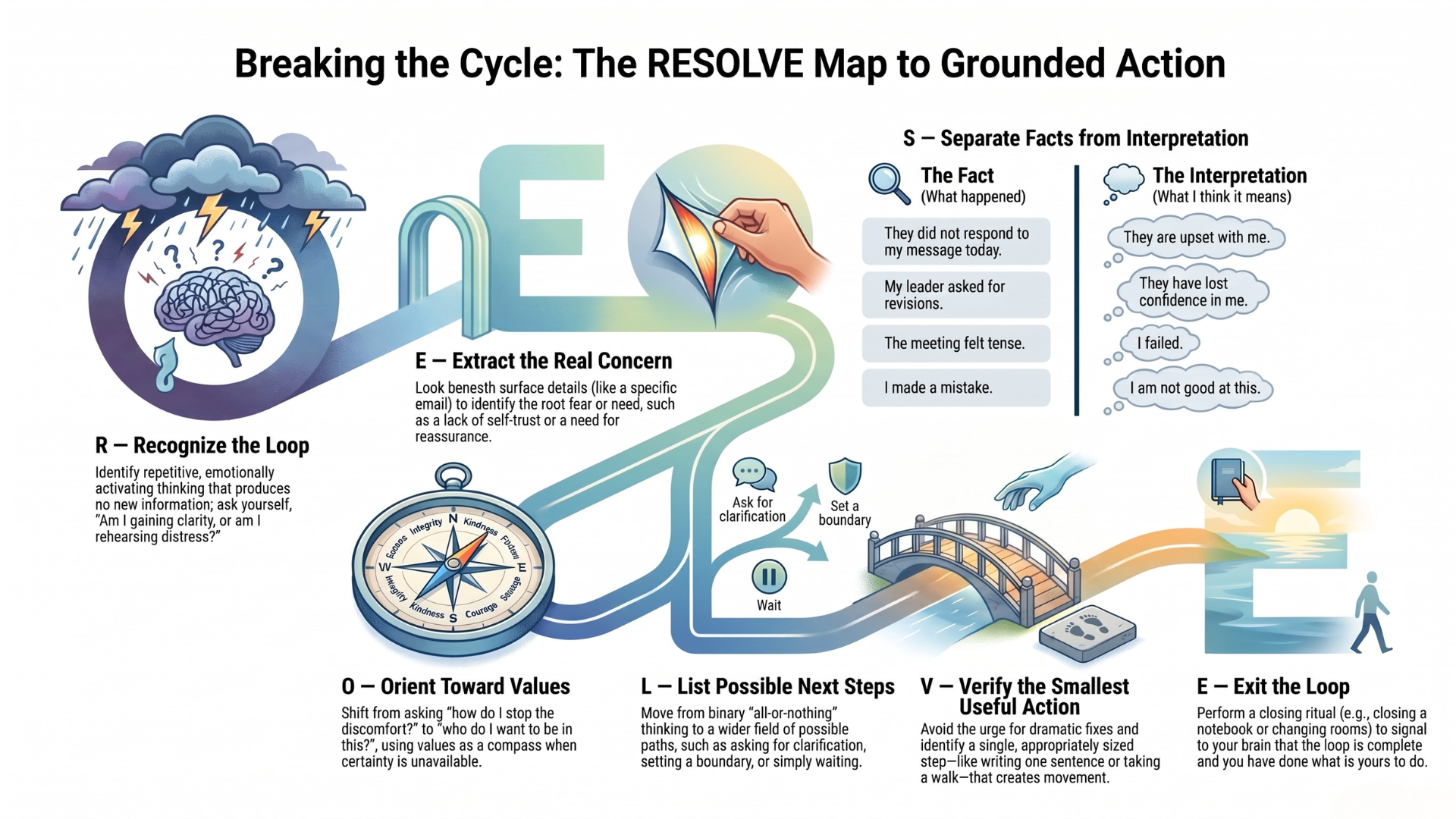
The R.E.S.O.L.V.E. Map
The R.E.S.O.L.V.E. Map is a practical way to move from mental looping to grounded action. It does not force you to ignore what happened or rush yourself into false positivity. Instead, it helps you slow the spiral, sort the signal from the noise, and identify the next useful step.
The goal is not to think less. The goal is to think more clearly.
R: Recognize the loop
The first step is noticing that you are in a loop.
This sounds simple, but it is often the hardest part. Rumination can disguise itself as preparation, reflection, responsibility, or analysis. It can feel like you are being diligent, when in reality you are walking the same mental hallway again and again, opening doors that lead back to the same room.
A loop often sounds like:
“What if I ruined everything?”
“Why did they say it that way?”
“What does this mean about me?”
“What if I make the wrong decision?”
“How could I have handled that better?”
“What if this keeps happening?”
The clue is not that you are thinking about something difficult. Difficult things deserve thought. The clue is that the thinking is repetitive, emotionally activating, and not producing new information.
A useful question here is: Am I gaining clarity, or am I rehearsing distress?
If the answer is rehearsing distress, you do not need to shame yourself. You simply need to name what is happening.
“I am in a loop.”
That one sentence creates a little space between you and the thought. It shifts the experience from being inside the storm to noticing the weather pattern.
E: Extract the real concern
Once you recognize the loop, the next step is to identify what the loop is really about.
Rumination often attaches itself to surface details. The exact wording of an email. The facial expression in a meeting. The pause before someone responded. The possible meaning of a comment. The thing you wish you had done differently.
But underneath those details, there is usually a deeper concern. The brain loops because something feels unresolved. Extracting the real concern helps you stop wrestling with every branch and start looking at the root.
Ask yourself: What am I actually afraid of, protecting, or needing here?
This question matters because rumination often multiplies concerns. It turns one moment into ten possible meanings. It creates a whole courtroom in your head, complete with prosecution, defense, surprise witnesses, and a judge who has not slept.
Extracting the real concern brings the room back to order. You may discover that the issue is not the email, the meeting, or the decision itself. The issue is uncertainty. Or belonging. Or self-trust. Or the need for a conversation you have been avoiding.
That is useful information.
S: Separate facts from interpretation
The brain is a meaning-making machine. This is one of its great strengths, and also one of its great sources of trouble.
When we are calm, we can usually tell the difference between what happened and what we think it means. When we are activated, those two things can blur together.
Fact: “They did not respond to my message today.” Interpretation: “They are upset with me.”
Fact: “My leader asked for revisions.” Interpretation: “They have lost confidence in me.”
Fact: “The meeting felt tense.” Interpretation: “I failed.”
Fact: “I made a mistake.” Interpretation: “I am not good at this.”
Interpretations are not always wrong. Sometimes they contain important signals. But when we treat interpretations as facts too quickly, we create unnecessary suffering and often respond to a story rather than reality. This step asks you to sort the evidence.
Create two columns in your mind or on paper:
What do I know?
What am I assuming?
This is not about invalidating your instincts. It is about giving your nervous system a cleaner map. When the brain is under threat, it tends to fill gaps quickly. It may favor negative interpretations because anticipating danger can feel safer than being surprised by it. But speed is not the same as accuracy.
Separating facts from interpretation helps you reclaim discernment. You may still decide there is something important to address. But now you are addressing it from steadier ground.
O: Orient toward values
Rumination often asks, “How do I make this discomfort go away?”
Resolution asks a better question: Who do I want to be in this?
Values help us move from reaction to intention. When we are caught in a loop, the brain often searches for certainty, approval, control, or emotional relief. Those are understandable desires, but they may not lead to the action we feel proud of later.
Orienting toward values helps restore agency. This step is powerful because values do not require perfect certainty.
You may not know exactly how someone else feels. You may not know whether the decision will work out. You may not know how the conversation will go. But you can still choose the quality of your next step.
Values act like a compass when the map is incomplete. They do not remove all discomfort, but they help you move with direction.
L: List possible next steps
Once you have identified the real concern, separated facts from interpretation, and oriented toward your values, it is time to generate options.
Rumination tends to narrow the field. It makes the situation feel binary: say everything or say nothing, stay or leave, confront or avoid, succeed or fail, fix it all or collapse dramatically into a pile of laundry.
Listing possible next steps widens the field again. The key word here is “possible.” You are not committing yet. You are simply showing your brain that more than one path exists.
Possible next steps might include asking for clarification, apologizing or repairing, or setting a boundary.
This step helps shift the brain from threat scanning to executive functioning. Instead of replaying the same fear, you begin to engage planning, discernment, and choice.
You are no longer trapped in “What does this mean?” You are moving toward “What could I do?”
V: Verify the smallest useful action
Not every next step needs to be big. In fact, when you are activated, the best next step is often smaller than your urgency suggests.
Rumination loves dramatic action. Send the long message. Rewrite the whole plan. Quit the thing. Fix the entire relationship. Solve the whole future by 3:00 p.m.
Resolution is usually quieter. It asks: What is the smallest useful action that would create movement, clarity, or relief?
Small does not mean insignificant. It means appropriately sized. A smallest useful action might be sending one clarifying question, scheduling the conversation, or writing the first sentence.
This step matters because the nervous system often wants closure immediately. But not all closure is available on demand. Sometimes the most useful action is not the one that resolves everything. It is the one that helps you stop spinning and re-enter your life.
Verification also asks you to check the action against your values and the facts. The smallest useful action is a bridge between insight and movement.
E: Exit the loop
The final step is often the one we forget. After you take the useful action, you have to exit the loop.
This does not mean the situation is magically resolved. It means you have done what is currently yours to do. Continuing to mentally rehearse may not add value. It may only keep your body living inside a problem you have already acted on.
The brain often needs a closing ritual. Not a dramatic one. Just a signal that the loop is complete for now.
You might write the action down. Close your notebook. Take three slow breaths. Stand up. Change rooms. Go outside. Drink water. Do something sensory. Move your body. Return to a task that matters.
The point is to teach your mind that resolution does not always require total certainty. Sometimes closure is a decision to stop feeding the loop.
A practical example
Imagine you leave a meeting feeling uneasy. Your leader seemed distracted, gave short responses, and asked you to revise a proposal. For the rest of the day, your mind keeps returning to it.
At first, the loop sounds like: “They hated it.” “I should have been more prepared.” “What if they do not trust me?” “Maybe I am not ready for this level of work.”
Using the R.E.S.O.L.V.E. Map, you might slow it down.
Recognize the loop: “I am replaying the meeting without gaining new clarity.”
Extract the real concern: “I am worried this affected their confidence in me.”
Separate facts from interpretation: Fact: They asked for revisions. Fact: They seemed distracted. Interpretation: They hated it. Interpretation: They do not trust me.
Orient toward values: “I want to be thoughtful, accountable, and clear.”
List possible next steps: I could revise the proposal. I could ask for more specific feedback. I could schedule a short follow-up. I could wait until I have made the requested changes.
Verify the smallest useful action: “I will send a concise note confirming the revisions I heard and ask if there is anything else they want me to strengthen.”
Exit the loop: “I have taken the next useful step. I will revisit this when I receive new information.”
The situation may not be fully resolved yet. But your relationship with it has changed. You have moved from rumination to response.
The deeper practice
The R.E.S.O.L.V.E. Map is not about becoming someone who never spirals.
You are human. Your brain is designed to notice threat, search for meaning, and seek closure. There will always be moments that tug at your mind after the meeting ends, after the conversation stops, after the decision is made, after the uncertainty arrives.
The practice is not to eliminate those moments. The practice is to recognize when thinking has stopped helping and started circling.
Processing creates movement. Rumination creates repetition. Processing helps you understand what matters. Rumination makes everything feel equally urgent. Processing connects you to values, choices, and grounded action. Rumination keeps you negotiating with ghosts.
When you notice yourself looping, you do not have to force yourself to “just stop thinking about it.” That rarely works. The brain does not usually respond well to being commanded into silence.
Instead, give it a better path. Recognize the loop. Extract the real concern. Separate facts from interpretation. Orient toward values. List possible next steps. Verify the smallest useful action. Exit the loop.
Resolution is not always a lightning bolt. Sometimes it is a lantern. Small, steady, and bright enough to show you the next few feet.
And sometimes, that is exactly enough.